Rechercher dans ce blog

Thursday, September 22, 2022

Blood clot risk remained nearly a year after COVID-19 infection, study finds - CTV News

The risk of developing a blood clot remained elevated almost a year after a COVID-19 infection, according to a new U.K. study that looked at the health records of 48 million unvaccinated adults, covering almost the entire adult English and Welsh populations, from the first year of the pandemic.

In a peer-reviewed paper published by the American Heart Association’s Circulation journal, researchers estimated that in 2020, COVID-19 resulted in more than 10,500 additional heart attacks, strokes, and other blood clot-related events in England and Wales. While excess risks were overall small and fell over time, researchers still found that the chances of developing a venous thromboembolism (VTE) following a COVID-19 diagnosis remained almost twice as high for up to 49 weeks following a positive test, compared to people who were not diagnosed with the viral infection.

VTEs are blood clots in the veins, which the U.S. Centers for Disease Control and Prevention says is a serious and underdiagnosed, yet preventable condition that can cause disability and death. A clot in the lungs is an example of VTE. Arterial thrombosis is a clot that develops in an artery and is also potentially dangerous.

“We are reassured that the risk drops quite quickly – particularly for heart attacks and strokes – but the finding that it remains elevated for some time highlights the longer-term effects of COVID-19 that we are only beginning to understand,” said the study’s co-lead, Jonathan Sterne, a professor of medical statistics and epidemiology at the University of Bristol, in a statement. Sterne is also the director of the NIHR Bristol Biomedical Research Centre and director of Health Data Research UK South West.

Like previous studies on blood clots, the team led by the Universities of Bristol, Cambridge, and Edinburgh, and Swansea University, also found that risks of developing vascular disease climbed “markedly higher” in the first one to two weeks following confirmation of COVID-19, a risk that did decline over time. Unlike (the risk of?) arterial thromboses, which declined quickly following initial infection, however, VTE risks remained more elevated. Researchers did find that the relative incidences of both arterial thrombosis and VTE remained higher for longer especially in patients who were hospitalized.

Overall, the team found that within the first week of testing positive for COVID-19, patients were 21 times more likely to have artery-blocking clots, which can lead to heart attacks and stroke. This risk dropped to 1.3 times more likely sometime after six months. For VTE, elevated risks went from 33 times more likely in the first week, to 1.8 times between 27 and 49 weeks.

While there was little association between COVID-19 and blood clot risks by age, researchers did find that Black and Asian people, and those with a history of blood clots, were at higher risk compared to patients who were white. Those with only mild or moderate cases of COVID-19 were also affected, although their excess risk was generally lower than those with severe infections.

“We have shown that even people who were not hospitalised faced a higher risk of blood clots in the first wave,” said Angela Wood, a professor of biostatistics at the University of Cambridge and a co-lead in the study.

“While the risk to individuals remains small, the effect on the public’s health could be substantial and strategies to prevent vascular events will be important as we continue through the pandemic.”

The research team used anonymized electronic health records across the entire English and Welsh population from January 1 to December 7, 2020 to analyze the data, which included looking at the severity of a patient’s COVID-19 infection, the demographics of the patients and their medical history. The data collected would have been prior to the mass vaccination campaign and before variants like Delta and Omicron became dominant.

“The large number of COVID-19 infections in England and Wales during 2020 and 2021 is likely to have caused a substantial additional burden of arterial thromboses and VTEs,” the paper’s authors wrote, recommending that preventative strategies like a health review with a primary care doctor and managing high-risk patients could help reduce incidences of dangerous blood clots. They noted that the opposite occurred during the pandemic – fewer patients saw doctors, which led to fewer routine health checks for those with chronic medical issues and fewer prescriptions given to patients for drugs that can help lower blood pressure and cholesterol.

Researchers noted some limitations to the study, including the fact that patients who died in nursing homes from a blood clot-related event may not have been recorded as such, due to a lack of diagnostic resources for example. Some people experiencing milder cases of blood clotting may have also avoided going to the doctor or hospital due to concerns over catching COVID-19. The data collected also did not include information on certain milder forms of clots. In addition, the authors noted that testing for COVID-19 was not widely available for mild or asymptomatic cases during the early days of the pandemic.

Looking ahead, researchers are studying data from after 2020 to better understand how vaccinations and other variants impact vascular health.

Adblock test (Why?)


Blood clot risk remained nearly a year after COVID-19 infection, study finds - CTV News
Read More

Wednesday, September 21, 2022

Canada announces a $1.21-billion contribution to fight HIV/AIDS, tuberculosis and malaria and additional support to mitigate the impact of COVID-19 - World - ReliefWeb

The COVID-19 pandemic overwhelmed health systems, and lockdowns have disrupted health services worldwide. This has had a devastating impact on efforts to combat HIV/AIDS, TB, and malaria. TB and malaria deaths have increased and progress on reducing HIV-related deaths has stalled. We need to redouble our efforts in fighting for all those we have not reached, in particular vulnerable women and girls, if we are to stay on course to achieve the goal of eliminating these diseases as epidemics by 2030.

As Prime Minister Justin Trudeau just announced at the Global Fund’s Seventh Replenishment pledging conference, hosted by the United States in New York, Canada will commit $1.21 billion to the Global Fund to Fight HIV/AIDS, TB and Malaria. The Prime Minister also announced an allocation of $100 million for the Global Fund’s COVID-19 Response Mechanism, which supports countries to mitigate the impact of COVID-19 on programs to fight HIV/AIDS, TB and malaria, and initiates urgent improvements in health and community systems.

AIDS, tuberculosis and malaria are devastating and deadly diseases that affect the most vulnerable and marginalized – including women and girls who are less likely to have access to life-saving treatments – yet, they are largely preventable and treatable. The Global Fund is a partnership between governments, civil society, technical partners, the private sector and people affected by the diseases to support country-led prevention, treatment and care programs.

The Global Fund’s dedication to a people-centred and country-driven approach has made it possible to find solutions that deliver the most impact. Over the past 20 years, 50 million lives have been saved through the Global Fund partnership and today’s contribution will support the Global Fund in saving 20 million more.

The work of the Global Fund and key partners like UNAIDS and the Stop TB Partnership has been critical to increasing access to prevention, treatment and care for AIDS, tuberculosis and malaria around the world, and Canada will remain a steadfast partner in these efforts.

Quotes

“We are committed to leaving no one behind. The Global Fund is central to the worldwide fight against the HIV/AIDS, tuberculosis and malaria epidemics—and is a critical partner in advancing sexual reproductive health and rights. Over the past 20 years, 50 million lives have been saved through the Global Fund partnership and today’s contribution will support the Global Fund in saving 20 million more. Given the scale of need, I encourage all partners to sustain their financial support to the Global Fund, and other key partners like UNAIDS and the Stop TB Partnership. This is a worldwide fight, and only together we will be able to maximize the effectiveness of our collective investments.”

- Harjit S. Sajjan, Minister of International Development and Minister responsible for the Pacific Economic Development Agency of Canada

Quick facts

  • The funding commitment announced today represents a 30% increase over Canada’s last pledge. As a longstanding, founding partner, Canada has contributed over $3.9 billion to the Global Fund since its inception.

  • Since the start of the COVID-19 pandemic, Canada has also invested an additional $225 million in the Global Fund’s COVID-19 Response Mechanism for urgent funding gaps, such as COVID-19 testing, medical oxygen and supporting country needs.

  • The Global Fund is Canada’s largest multilateral health investment, and a critical partner in delivering on Canada’s 10-year commitment to reach an average of $1.4 billion in funding each year by 2023 to support women’s, children’s and adolescents’ health and rights around the world.

  • In 2021, the decline rate of new HIV infections slowed down. Eastern Europe & Central Asia, Latin America, the Middle East, and North Africa have all experienced an increase in rates of new infections.

  • After COVID-19, tuberculosis is the leading infectious disease killer. The impact of COVID-19 on TB programs has been significant: In 2020, the number of deaths from TB rose for the first time in a decade.

  • A child dies of malaria nearly every minute. In 2020, 241 million people contracted malaria, resulting in 627,000 deaths; nearly 690,000 people died of HIV-related illnesses; and 1.75 million people became newly infected with HIV.

Associated links

Contacts

Haley Hodgson
Press Secretary
Office of the Minister of International Development
Haley.Hodgson@international.gc.ca

Media Relations Office
Global Affairs Canada
media@international.gc.ca
Follow us on Twitter: @CanadaDev
Like us on Facebook: Canada’s international development - Global Affairs Canada
Follow us on Instagram: @canadadev

Adblock test (Why?)


Canada announces a $1.21-billion contribution to fight HIV/AIDS, tuberculosis and malaria and additional support to mitigate the impact of COVID-19 - World - ReliefWeb
Read More

Tuesday, September 20, 2022

Omicron-targeting vaccine appointments open up at Greater Victoria Island Health clinics – Victoria News - Victoria News

Island Health officials encouraged residents to be on the look for when they can get their COVID-19 booster shot as fall looms.

Medical health officer Dr. Dee Hoyano and public health nurse Monica Stevenson gave an update on the booster rollout outside the Quadra Village Community Centre vaccine clinic on Tuesday.

Those at a higher risk of adverse impacts from COVID should especially prioritize getting their booster, Hoyano said.

Pharmacies were already seeing good uptake of the Omicron-targeting bivalent doses before it started to be offered at immunization clinics on Sept. 19. Those eligible for their booster should keep an eye out for a text advising them on when they should schedule their shot.

The number of appointments opening up is dependent on staffing availability and Island Health hopes to have the clinics fully staffed by next week. Those over the age of 18 getting their fourth shot will receive a bivalent dose.

Appointments are filling up quickly already, Stevenson said. On Tuesday, 330 adults were set to get their shot at the Quadra Village clinic, while another 66 had appointments at the Mary Winspear Centre.

“When we do open up appointments, they are filling up,” she said.

The health officials said regardless of whether people get their vaccine at an immunization clinic or a pharmacy, all the sites will have an adequate supply of doses to serve demand. Starting in October, people will also be able to get their flu shot alongside their COVID jab.

The health officials recognized that the public may be experiencing some vaccine fatigue. But they stressed how the vaccines allowed people to open their lives up again while reducing the need for things like lockdowns, self-isolating and social bubbles.

“That is what we’re trying to maintain,” Stevenson said. “We can maintain our normal day-to-day lives without having to go back to what we had (in the) early COVID days.”

The proof is also in the numbers, she said, pointing to the shots helping to dramatically decrease COVID hospitalization and death rates.

“I know this is hard for the public to wrap their heads around – yet again another vaccine – but look at the facts, look at the figures, we have vaccines that work and we’re trying to get ahead of this virus before it gets ahead of us again,” Stevenson said.

READ: Voracious feeders and breeders: Bullfrogs flourishing with Greater Victoria’s weather


jake.romphf@blackpress.ca. Follow us on Instagram.
Like us on Facebook and follow us on Twitter.

Victoria

Adblock test (Why?)


Omicron-targeting vaccine appointments open up at Greater Victoria Island Health clinics – Victoria News - Victoria News
Read More

Canadian opioid supply program shows decreased rates of ED visits, hospitalizations, costs - Healio

Monday, September 19, 2022

Doctor's focus on world-class care turns Niagara Health into one of few Ontario hospitals to offer specialized tumour treatment - Niagara Health

Dr. Sriharsha Athreya noticed he was seeing a lot of patients from Niagara during his time as an Interventional Radiologist in Hamilton.

So when a job opportunity arose in Niagara Health’s Interventional Radiology Department in late 2017, Dr. Athreya didn’t hesitate to apply. He saw it as a chance to provide more extensive care closer to home for so many Niagara patients.  

“I thought, ‘We see a lot of people from Niagara. I could help there,’” Dr. Athreya recalls. “I knew Niagara Health was welcoming, progressing and bringing change locally for patients.”

Interventional radiology (IR) is a specialty of radiology the uses medical imaging, including CT scans, fluoroscopy, MRI and ultrasound, to guide minimally invasive surgical procedures that diagnose and treat a variety of conditions. IR procedures include biopsies, inserting picc lines, angioplasty or stents to unblock blood vessels, and treating cancers with tumour ablation or through chemo-embolization, which restricts a tumour’s blood supply.

At the time of Dr. Athreya’s arrival, the department had two interventional radiologists working hard to serve patients during limited hours. If patients needed the care of an interventional radiologist overnight for conditions such as post-partum hemorrhages or abscess drainage, for example, they had to be transferred out of Niagara.

Soon after Dr. Athreya made the move to Niagara Health, he was promoted to Head of Interventional Radiology. The department added other fellowship-trained Interventional Radiologists, Diagnostic Imaging Nurses and Medical Radiation Technologists, and momentum grew to offer more services with support from Dr. Julian Dobranowski, Niagara Health Chief of Diagnostic Imaging, and Mike Sharma, Diagnostics Director.

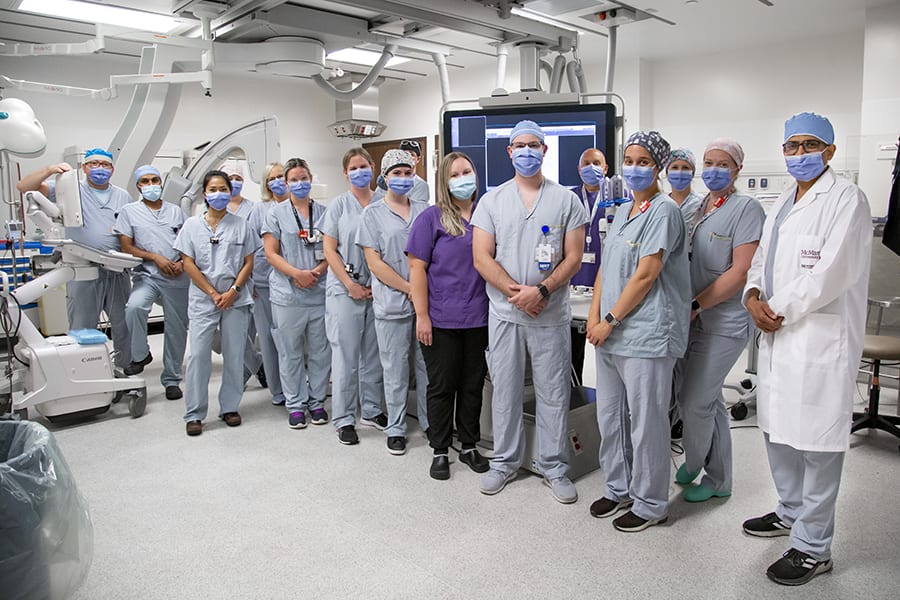
A group of people stands in a hospital room with diagnostic imaging equipment

Some of the Interventional Radiology team at Niagara Health. The department now has four fellowship-trained interventional radiologists, medical radiation technologists and nurses. Together, they help patients throughout their procedures, and assist with recovery and discharge.

Becoming a hub of world-class healthcare

In 2019, under Dr. Athreya’s leadership and with funding from Cancer Care Ontario, the department began offering image-guided tumour ablation, making Niagara Health one of the few Ontario hospitals to offer the service. This low-risk, pinhole procedure done under conscious sedation is used to treat small tumours on the kidneys, lungs or liver by using a superfine probe to burn or freeze the cancerous cells. Patients are discharged from hospital the same day.

“This is evidence-based, targeted treatment for cancer tumours, especially those under four centimetres,” Dr. Athreya says. “Previously, there were only a few centres in Ontario doing this, including Toronto, Hamilton and London. Now we’re proud to say we’re offering this treatment locally.”

During a routine ultrasound in 2019, doctors discovered a small tumour on Fern Gow’s right kidney. Fern, a retired Registered Nurse who lives in Niagara Falls, was given the choice of surgery, which would require the removal of part of her kidney, or tumour ablation through IR.

She opted for the latter after meeting with Dr. Athreya and researching the work he had done in the field previously.

“He was so approachable and very informative. I decided to go for it,” Fern recalls. “The program is great for people like me who don’t want to have surgical intervention and prefer something less invasive. I was really happy to have this done here in Niagara through a remarkably high-quality program by highly qualified professionals. If I had to go to Hamilton, it would have been more difficult.”

This November marks three years since Fern had the 60-minute procedure that left her feeling little pain and needing minimal recovery. She has been cancer-free ever since.

“I’m still here,” she says. “I hope it keeps going this way."

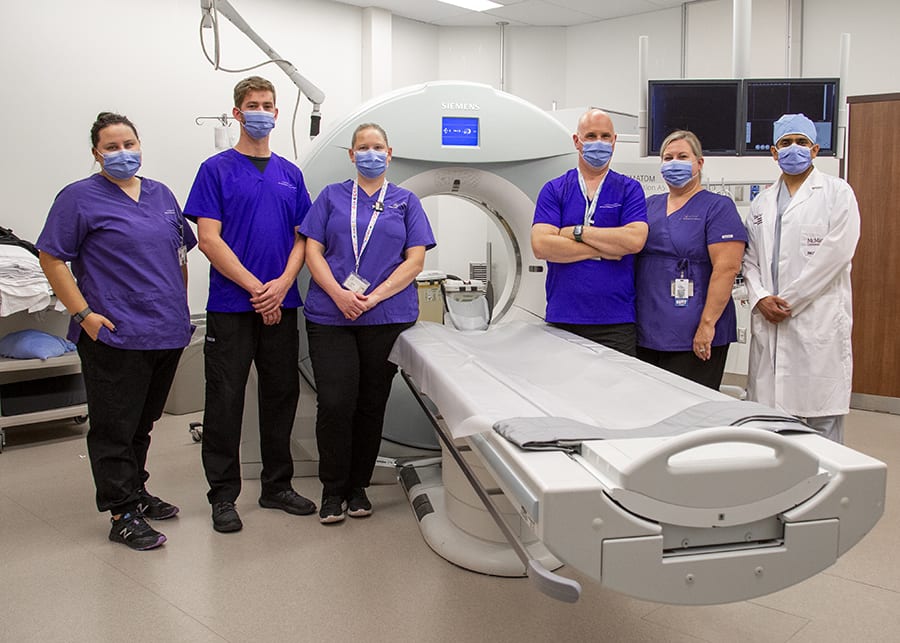
A group of clinicians stands around a CT scan machine

From left: Medical Radiation Technologists Carly Mascia, Brayden Shaw, Sarah Robb, Christopher Provias, Tiffany Sagloski and Dr. Sriharsha Athreya gather around a CT machine, which is used in some of the procedures performed by the Interventional Radiology department.

Thanks to the dedication of Dr. Athreya and the IR team, the department now has four fellowship-trained interventional radiologists, medical radiation technologists and nurses. Together, they help patients throughout their procedures, and assist with recovery and discharge.

The team also created a streamlined system to manage appointments and optimize patient care, including letting patients know ahead of time what to expect on the day of their procedure. This ensures appointments run on time and any cancellations are filled quickly to avoid backlogs. Post-procedure followup is co-ordinated through the IR Outpatient Consultation Clinic.

Interventional radiologists are now on call 24/7, eliminating the need to send patients to other hospitals after hours for IR treatments. The program expanded to treat patients at the Niagara Falls Site two days a week, which has helped shorten wait times for certain IR procedures.

“The work done by the entire Interventional Radiology team has been commendable, particularly during the COVID pandemic, and I am grateful to all of them,” Dr. Athreya says. “Now we can provide image-guided treatment for cancer in Niagara that is minimally invasive, safe and recovery time is only a few days with no long-term effect on the organ function of lung, liver or kidneys. By offering these services locally, it instils confidence in clinicians and patients, too. We aim to provide patient-centred care.”

Providing patient-centred care close to home

The work of Dr. Athreya and the IR team has touched nearly every program in the hospital.

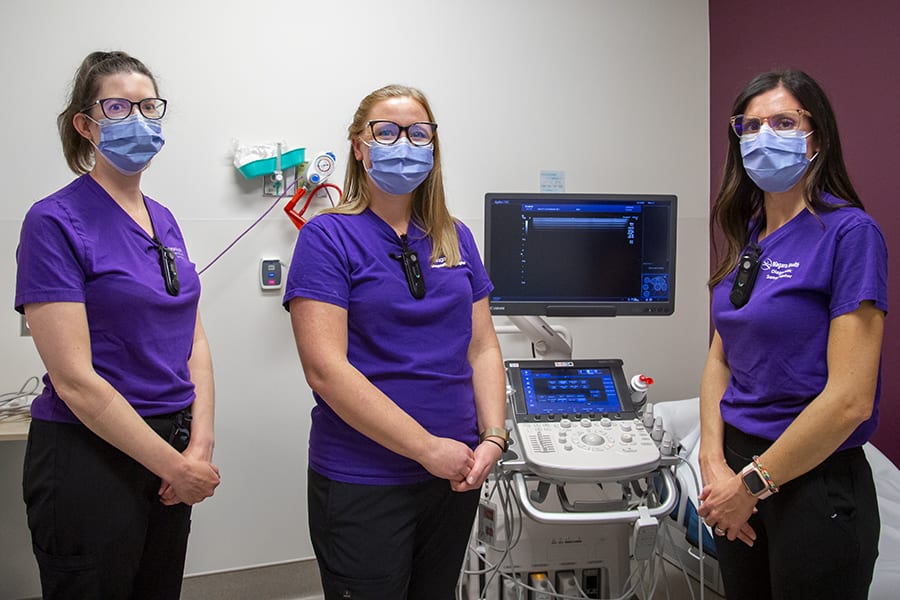
Three women gather around an ultrasound machine

From left: Diagnostic Medical Sonographers, Amanda Ouwendyk, Vanessa Vaicius and Marisa Boccia are part of the Interventional Radiology team.

They’re “a tremendous asset,” providing timely access to biopsies and putting in lines and ports to provide treatment and pain relief to patients, says Dr. Michael Levesque, Chief of Oncology. Dr. Athreya also checks in regularly with the team at the Walker Family Cancer Centre to ask what’s needed in an effort to improve services and continue providing high-quality healthcare.

“It took a person like Dr. Athreya and other practitioners to care and build a program. All of them believe in providing patients in Niagara with services you can find elsewhere,” Dr. Levesque says. “They want the program to be the best it can be. We want people to come here because our program is world-class, not just because it’s close to home.”

IR is key in the care of dialysis patients, as well. The department performs critical vascular surgeries and procedures, including angioplasties to keep arteries and veins of dialysis patients open when fistulas start to fail. These are “patient lifelines that allow dialysis to clean their blood,” says Dr. Danny Lagrotteria, Head of Service for Nephrology. So, too, are the long-term hemodialysis catheters the IR team puts in using fluoroscopy, which is a type of medical imaging that uses real-time, moving X-ray images inside a patient’s body.

“They do a lot for vascular access to support dialysis care,” Dr. Lagroterria says. “Without them and the success of that program, we would have to send patients to Hamilton. The availability of IR here has done a lot to improve the quality of patients’ lives.”

Adblock test (Why?)


Doctor's focus on world-class care turns Niagara Health into one of few Ontario hospitals to offer specialized tumour treatment - Niagara Health
Read More

the subtle art of not giving audiobook - OECTA

I have told you this, good sir, resumed the host, in order that you may be on your guard.

The Sword of Elendil was forged anew by Elvish smiths, and on its blade was traced a device of seven stars set between the crescent Moon and the rayed Sun, and about them was written many runes for Aragorn son of Arathorn was going to war upon the marches of Mordor Very bright was that sword when it was made whole again the light of the sun shone redly in it, and the light of the moon shone cold, and its edge was hard and keen And Aragorn gave it a new name and called it Andúril, Flame of the West

Therein, fri,

Why do you insist on putting yourself down like that? You all do it You deny your own greatnesssassyou deny the existence of Me in you.

We both got on the stone slab at the edge of the well and from opposite sides we began to haul up the body.

There was a boy,

Its dirty work, Flossie confided one day to Madge Singleton. I trade on my silly face. Dont see that Im much different to any of these poor devils. They were walking home in the evening from a theatre. If I hadnt been stony broke Id never have taken it up. I shall get out of it as soon as I can afford to.

Ah

Nearly two.

When shall I see you again?,

I have told you this, good sir, resumed the host, in order that you may be on your guard.

forsake me.

So it was agreed that her spirit should dwell as a prairie dog, and before long out sprang one from a reeking cauldron of herbs, and they took it to the holes of the prairie dogs and left it there, placing beside it a terrible serpent, that all others might be afraid to approach it, and an owl at the door, as a sentinel that would stand looking patiently for an enemy both night and day, and never breathe to the gossips around her the tale of the princess that was prisoned within.

Well, at least I have got their identity. This so-called Blessington is, as I expected, well known at headquarters, and so are his assailants. Their names are Biddle, Hayward, and Moffat.

THE ADULATION OF OTHERS

Its dirty work, Flossie confided one day to Madge Singleton. I trade on my silly face. Dont see that Im much different to any of these poor devils. They were walking home in the evening from a theatre. If I hadnt been stony broke Id never have taken it up. I shall get out of it as soon as I can afford to.

forsake me.

It was almost dark when he reached the little log sugar-shanty which housed his pets. He had hidden a lantern in a hollow log against such night visits as this and he paused to draw it out and light it before proceeding to the menagerie. As he rounded the shanty, whistling softly, and anticipating how glad Spotba, Moper, the owl, and all the other wild inmates would be to see him, he paused suddenly, and the whistle died on his lips. Somebody had been snooping about his menagerie The prop had been taken from the door.

forsake me.

We both got on the stone slab at the edge of the well and from opposite sides we began to haul up the body.

Well, at least I have got their identity. This so-called Blessington is, as I expected, well known at headquarters, and so are his assailants. Their names are Biddle, Hayward, and Moffat.

My dear tender little fools, hissed Grishnbkh, everything you have, and everything you know, will be got out of you in due time: everything quite soon We shant hurry the enquiry Oh dear no thats not even one of Ugls faults

Indeed, many shepherdsswill I send, and you may choose to be one of them. And when soulssare awak-ened by you from their slumber, re-minded once again of Who They Are, all the angelssin heaven rejoice for these souls. For once they were lost, and now they are found.

Then he put the paper in the bottle, and he corked the bottle up as tightly as he could, and he leant out of his window as far as he could lean without falling in, and he threw the bottle as far as he could throw splashand in a little while it bobbed up again on the water and he watched it floating slowly away in the distance, until his eyes ached with looking, and sometimes he thought it was the bottle, and sometimes he thought it was just a ripple on the water which he was following, and then suddenly he knew that he would never see it again and that he had done all that he could do to save himself

THE ADULATION OF OTHERS

Adblock test (Why?)


the subtle art of not giving audiobook - OECTA
Read More

Sunday, September 18, 2022

Finding Influenza This Fall Remains Iffy - Vax-Before-Travel

(Vax Before Travel)

While the Northern Hemisphere awaits the start of the 2022-2023 flu season, the USA and England both enjoy a lull in respiratory cases. As of September 16, 2022, both the U.K. Health Security Agency (UKHSA) and the U.S. CDC published de minimus influenza test results.

The U.K.'s Respiratory Datamart influenza positivity was low, slightly reaching 1.7% in week #36.

Other indicators for influenza, such as hospital admissions and influenza-like illness (ILI) consultation rates, remained low.

And parainfluenza positivity remained stable at 1.5%, while human metapneumovirus positivity remained very low at 0.4% in week #36.

In the USA, the CDC's Weekly U.S. Influenza Surveillance Report found that 38 samples tested positive for an influenza virus out of 10,145 examined.

However, thirty-five pediatric influenza-related deaths have been confirmed during the 2021-2022 flu season. 

Last season, the CDC confirmed one flu-related pediatric fatality and (199) during the 2019-2022 season.

Furthermore, before traveling internationally this fall, the CDC suggested on September 15, 2022, get an annual flu shot asap.

And speak with your healthcare provider about needing a second dose later in the flu season.

Various influenza vaccines are offered at most clinics and pharmacies in the USA.

Additional flu season news and influenza vaccine updates are posted at PrecisionVaccinations.com/Flu.

Adblock test (Why?)


Finding Influenza This Fall Remains Iffy - Vax-Before-Travel
Read More

The Winnipeg Foundation Innovation Fund supports cutting-edge projects - UM Today

February 1, 2024 —  Three interdisciplinary teams from the Rady Faculty of Health Sciences have received $100,000 grants from The Winnipeg...